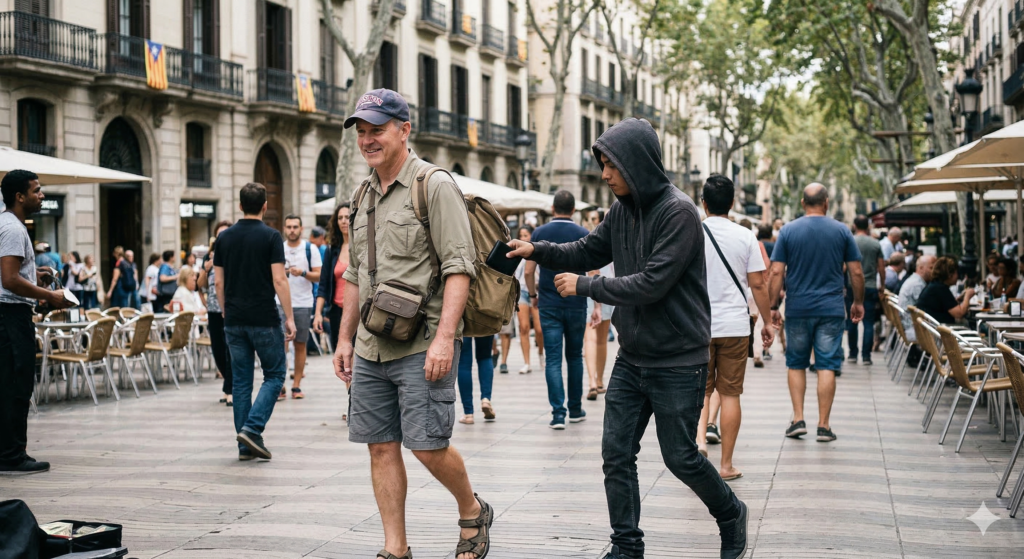
Let me tell you about my friend Dave.
Dave is a smart, experienced traveler. He’s been to 40+ countries. He speaks a little Spanish, a little French, and enough Thai to order food confidently. Dave is not a naive tourist. And Dave got pickpocketed on the Barcelona Metro in broad daylight with his hand on his pocket and didn’t notice until he was off the train.
That’s how good professional pickpockets are.
OK Dave’s not real. I know a lot of people like Dave though. People who have been pickpocketed in Barcelona. Or had their purse snatched off their shoulder at CDG Airport in Paris. Or their camera bag stollen in front of the fountain at The Louvre with a group of photographers standing next to it. The point is we are all Dave these days.
The good news: travel security gear has gotten seriously good. We’re not talking about the clunky money belts and sweaty neck pouches of the old days (though I’ll get to those). We’re talking slim, RFID-blocking wallets with built-in AirTag slots, hidden-pocket clothing that looks completely normal, and cross-body bags with locking zippers that would take a determined thief a lot longer to crack than the time they have.
Let’s talk about what’s actually worth buying in 2026 and why.
Why This Stuff Matters More Than You Think
Here’s a thing that will put a damper on your trip faster than a cancelled flight: arriving in a new country, reaching for your wallet, and finding it gone. Your credit cards. Your ID. Your cash. Your driver’s license. All of it.
Beyond pickpocketing, there’s a more modern threat most travelers don’t think about: RFID skimming. Modern credit cards and passports have RFID chips that can be scanned wirelessly by someone with a reader standing near you in a crowd. Just being next to the wrong person in a busy market could compromise your card details.
I spent over 25 years working in IT, and I want to tell you firsthand how easy this actually is. With a cheap reader you can buy online for under $50, someone with basic technical knowledge can skim an RFID number from several feet away without touching you or your bag. It’s not common, but it IS possible. and most people have no idea it’s even a thing. An RFID-blocking wallet costs about the same as two cocktails at an airport bar. It’s not a hard call.
The goal with travel security gear isn’t to be paranoid. It’s to make yourself the harder target. Pickpockets take the path of least resistance. If your stuff is harder to get to than the next person’s, they move on.
The Best RFID Wallets with AirTag Holders
This is the category that’s had the most innovation recently, and the options are genuinely impressive.
Ekster Wallet with Ekster Finder Card: Best Overall
If I had to pick one wallet to recommend right now, it’s the Ekster. Here’s why: it looks great, it’s slim enough to sit comfortably in your front pocket, and it has a dedicated AirTag pocket built into the design rather than awkwardly crammed in as an afterthought. The patented card ejection mechanism means you can fan out your cards with a button press, RFID blocking is built in, and it holds up to 17 cards i(depending on the model).
Is it cheap? No. Is it worth it? Yes. I have an earlier version that I’ve had for years and use every day.
Dango D01 AirTag Wallet: Best for Durability
If you’re harder on your gear than most, the Dango D01 AirTag Wallet is built like a tank. It’s made from 6061 space-grade aluminum (the same grade used in aircraft parts) with a silicone band to hold the AirTag securely. It holds up to 10 cards, has RFID blocking, and also features a built-in bottle opener because apparently that was a design requirement and honestly I respect it. Extremely rugged. Extremely satisfying to hold.
LORZOR Leather AirTag Wallet: Best for Traditional Style
Not everyone wants to look like they’re carrying a piece of spacecraft. If you prefer a more classic look, the LORZOR is full-grain waxed leather with RFID blocking and room for 10 cards, plus an integrated AirTag slot. It ages beautifully, the kind of wallet that gets better with every trip.
Hidden Pocket Clothing: Looking Normal While Staying Protected
Here’s my honest take on money belts: I don’t love them. No offense to Rick Stevens, but the classic under-shirt pouch is uncomfortable, sweaty in hot weather, and requires you to do an awkward shirt-lifting maneuver every time you need to pay for something. There’s a better way.
Hidden pocket clothing has gotten genuinely sophisticated. Here are the categories worth knowing.
Hidden Pocket Travel Pants and Shorts
Brands like Scottevest, Bluffworks, and ExOfficio make travel pants with hidden zip pockets built into the waistband, thigh panels, or behind belt loops. Those are places a pickpocket wouldn’t think to check and wouldn’t be able to access quickly anyway. They look like completely normal pants. Nobody knows. This is the move.
Pro tip: Keep your emergency cash and backup card in a hidden waistband pocket. Keep your everyday spending money in your regular wallet. If you get pickpocketed you lose your spending cash, which is annoying but not catastrophic.
Hidden Pocket Scarves and Belts
This sounds ridiculous but works brilliantly, especially for women travelers. A scarf with a zippered interior pocket is genuinely invisible to anyone watching. Same with slim belt wallets that sit flat against your body. These are particularly good for carrying your passport when you need it on your person.
Day Bags with Anti-Theft Features
If you’re carrying a daypack, the bag itself is worth thinking about. Look for locking zippers (pulls that clip together and require two hands to open), cut-resistant panels (some bags use Dyneema or similar fabric that can’t be slashed), and hidden back panels (a zipped pocket against your back that’s inaccessible while you’re wearing the pack).
Pacsafe and Travelon both make solid anti-theft bags at reasonable prices. They’re not as stylish as some competitors, but they’re genuinely secure.
The AirTag Game: Tracking Your Stuff When It Matters
Apple AirTags (and their Android equivalents like Samsung SmartTags and Tile trackers) have become an essential part of my travel kit. Here’s how I use them.
In checked luggage. This is the obvious one. An AirTag tucked into your suitcase means you can watch it move through baggage handling on your phone. If your bag goes to the wrong city, you know immediately and you have proof for the airline. I’ve heard from multiple travelers who recovered missing luggage faster because they could tell the baggage agent exactly where the bag was.
In your backpack. If your daypack gets stolen or left somewhere, there’s a real chance of recovery if you’re in a city with a reasonable density of Apple devices (which is most major cities worldwide at this point).
In your camera bag. If you’re traveling with serious camera gear, an AirTag in the bag is cheap insurance.
What they won’t do. AirTags work on the Find My network, which requires being near another Apple device to update their location. In remote areas, they’re less useful. And a determined thief who knows about AirTags can find and remove one. But for opportunistic theft and lost luggage? They’re fantastic.
Slim AirTag holders designed for wallets (see the Ekster and Dango above) are the cleanest solution. You get tracking without carrying a separate device.
The Stuff People Forget (But Shouldn’t)
A few more security items that tend to get overlooked.
A combination cable lock. A $15 TSA-approved cable lock lets you loop your bag strap around a fixed object like a train seat, a hostel bunk bed frame, or a café table leg so nobody can grab your bag and run. Not foolproof, but a very effective deterrent.
Photocopies (or photos) of your documents. Keep a photo of your passport, travel insurance, and emergency credit card on your phone and in a secure cloud folder. If everything gets stolen, these will make your life so much easier.
A separate emergency card. Keep one credit card in a different location from your wallet. A hidden pocket, your hotel safe, or the bottom of your luggage all work. If your wallet goes, you’re not completely stranded.
Hotel safe hygiene. Use it. Every time. For your passport, backup card, extra cash, and camera gear you’re not taking out. Yes, the safe is not impenetrable. It’s still vastly better than leaving valuables on the dresser.
What’s Actually Worth Buying?
Here’s my honest priority list if you’re building out your travel security kit from scratch:
- An RFID-blocking wallet with AirTag slot (Ekster if budget isn’t a concern, Hawanik if it is)
- AirTags/Andorid Equivalents for your checked bag and main daypack
- Travel pants with hidden waistband pocket for one backup card and emergency cash
That’s it. You don’t need to spend a fortune or look like you’re going undercover. You just need to be a slightly harder target than the person next to you.
Travel is overwhelmingly safe. Most people go their whole lives without being robbed on the road. But the 20 minutes it takes to set up your security kit is very much worth the peace of mind on every trip afterward.
Got a travel security setup that works for you? Had a close call (or unfortunately, not a close call)? Tell me about it in the comments. The community here has given me some of my best gear tips and I’d love to keep that going.